
You've got a rock-star team. Your engineers know every bolt and specification. Your project managers have run similar work a dozen times. Your proposal writers can craft compelling narratives in their sleep. Yet somehow, your technically superior proposal just lost to a competitor who: on paper: seemed less qualified.
Sound familiar? It happens more often than you'd think, and the culprit isn't incompetence or bad luck. It's something far more insidious: the blind spots that come from knowing your solution too well.
The Problem With Internal Expertise
Here's the uncomfortable truth about external proposal review: your greatest strength as a team: deep product knowledge and organizational expertise: becomes your greatest weakness when it's time to evaluate your own proposal through fresh eyes.
Internal teams, even dedicated Red Teams, suffer from what psychologists call "curse of knowledge." You know your solution works because you've lived it, breathed it, and solved real problems with it. But that intimate familiarity creates blind spots that can torpedo even the strongest proposals.

Think about it this way: when your team reviews a section about your proprietary software, you automatically fill in gaps because you understand the underlying technology. When government evaluators read that same section, they don't have your context. They see only what's on the page: and if it's unclear, incomplete, or assumes knowledge they don't have, you lose points.
What Government Evaluators Actually Care About
Government evaluators don't care how much you love your solution. They don't care that it saved your last client millions or that you've been perfecting it for years. They have one job: score proposals based on what's written, following strict evaluation criteria focused on three core areas.
Compliance comes first. Did you answer every requirement? Did you follow the format? Did you include all required documentation? Miss one compliance item, and your technically brilliant proposal could be eliminated before evaluators even consider your approach.
Clarity ranks second. Can evaluators understand your solution without being domain experts? Is your methodology clear? Are your timelines realistic and well-explained? Government evaluators often represent diverse backgrounds: your proposal needs to make sense to all of them.
Proof rounds out the trinity. Can you demonstrate that your approach will work? Do you have relevant past performance? Are your cost estimates realistic and well-supported? Evaluators want evidence, not promises.

The disconnect happens because internal teams focus on what they know works, while evaluators focus on what they can verify from the written proposal alone.
Common Mistakes Even Strong Teams Make
I've seen technically excellent teams lose winnable contracts because they made predictable mistakes during self-review. These aren't novice errors: they're blind spots that affect experienced contractors year after year.
Assumption creep tops the list. Your team assumes evaluators understand industry standards, common practices, or basic technical concepts. You write "utilizing standard protocols" without defining what those protocols are. You reference "typical project phases" without explaining your specific approach. Evaluators don't share your assumptions.
Solution-focused writing creates another trap. Internal teams love talking about their solution's features and capabilities. But evaluators want to see how your solution addresses their specific requirements. They don't care that your software has 47 advanced features: they care whether it solves their clearly defined problem.
Process blindness hits even seasoned proposal teams. You're so familiar with your internal processes that you forget to explain them clearly. Your quality assurance section says "we follow rigorous QA procedures" without describing what those procedures actually involve or how they benefit the government.
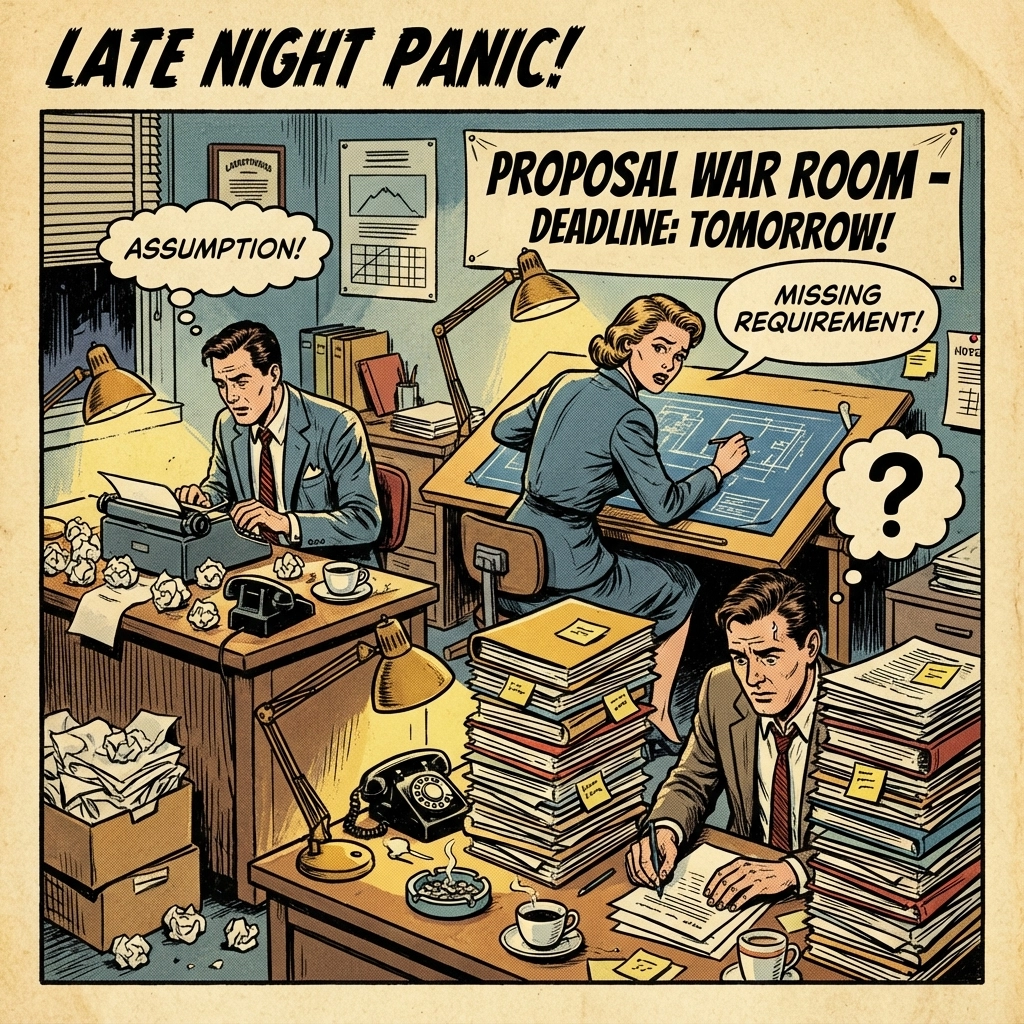
Compliance assumption creates expensive losses. Internal teams often assume they've met requirements because they understand the underlying need. But evaluators score based on explicit requirement language. If the RFP asks for "weekly status reports" and you only mention "regular communication," you've failed that requirement regardless of your intent.
How External Reviews Mirror Government Evaluation
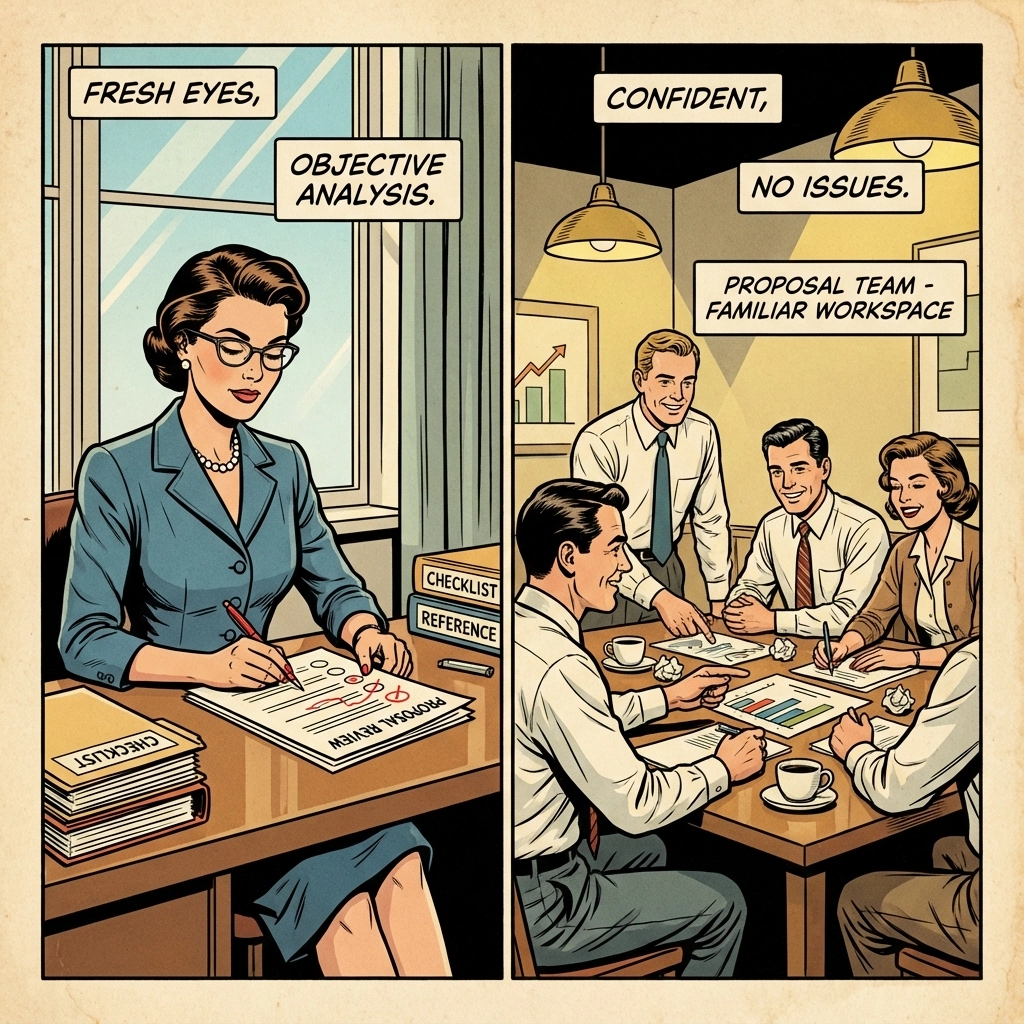
External reviewers bring the same objectivity and distance that government evaluators apply to your proposal. They don't know your solution, your team, or your good intentions. They see only what you've written: just like real evaluators.
This perspective reveals gaps in three critical areas that internal teams consistently miss.
Requirement traceability becomes obvious to outside eyes. External reviewers quickly spot where you've addressed requirements implicitly rather than explicitly. They'll flag sections where you assume evaluators will connect the dots between your capability description and specific RFP requirements.
Writing clarity jumps out to fresh readers. What seems perfectly clear to your team: because you understand the context: often confuses outsiders. External reviewers identify convoluted sentences, undefined acronyms, and logical gaps that make evaluators work harder to understand your approach.
Evidence sufficiency reveals itself through objective analysis. Internal teams often believe they've provided adequate proof because they know their track record. External reviewers evaluate evidence with the skepticism evaluators bring: Is this specific? Is it relevant? Is it convincing?
The Outsider Advantage
External reviewers see risky assumptions that internal teams miss because those assumptions have become invisible through familiarity. When your team writes about "leveraging existing partnerships," everyone nods because they know those partnerships are solid. External reviewers ask: What partnerships? How will they benefit this project? Why should evaluators care?
This questioning mindset mirrors how government evaluators approach proposals. They're not hostile, but they're skeptical. They want proof, not promises. They need clarity, not cleverness.
External reviews also catch compliance risks that internal teams overlook. When you're deeply familiar with your capabilities, it's easy to assume you've addressed every requirement. Outside reviewers approach compliance mechanically: checking every requirement against every section: the same way evaluation teams work.
Perhaps most importantly, external reviewers identify unclear claims that could hurt your evaluation scores. Internal teams often write about their "proven methodology" or "innovative approach" without providing the specific details that government evaluators need to assign points.
The Bottom Line on External Proposal Review
You can't evaluate your own proposal the way government evaluators will. Your expertise creates blind spots that cost contracts. Your familiarity breeds assumptions that evaluators don't share. Your investment in your solution makes objective assessment nearly impossible.
External reviews bridge this gap by providing the objective, skeptical perspective that mirrors real evaluation environments. They spot compliance risks, unclear writing, and unsupported claims that internal teams consistently miss.
Don't wait until after submission to discover where you lost points. Transform your review process with insights from people who've sat on the other side of the evaluation table.
Ready to see your proposal through evaluator eyes? Our external review process helps government contractors identify and fix the gaps that cost contracts. We've helped teams win millions in federal work by spotting the blind spots that internal reviews miss.
Contact us today to learn how our objective review process can strengthen your next proposal, or explore our services to discover comprehensive solutions for government contracting success.
For more insights on winning government contracts, check out our analysis of why throwing money at BD consultants won't win contracts and our guide to leveraging incumbent advantage in recompetes.
External sources: Research shows that organizations using external proposal reviewers see measurably higher win rates, with studies indicating improvements of up to 30% in proposal acceptance rates. For comprehensive guidance on proposal best practices, consult the Federal Acquisition Regulation (FAR) and review resources from the Association of Proposal Management Professionals (APMP).